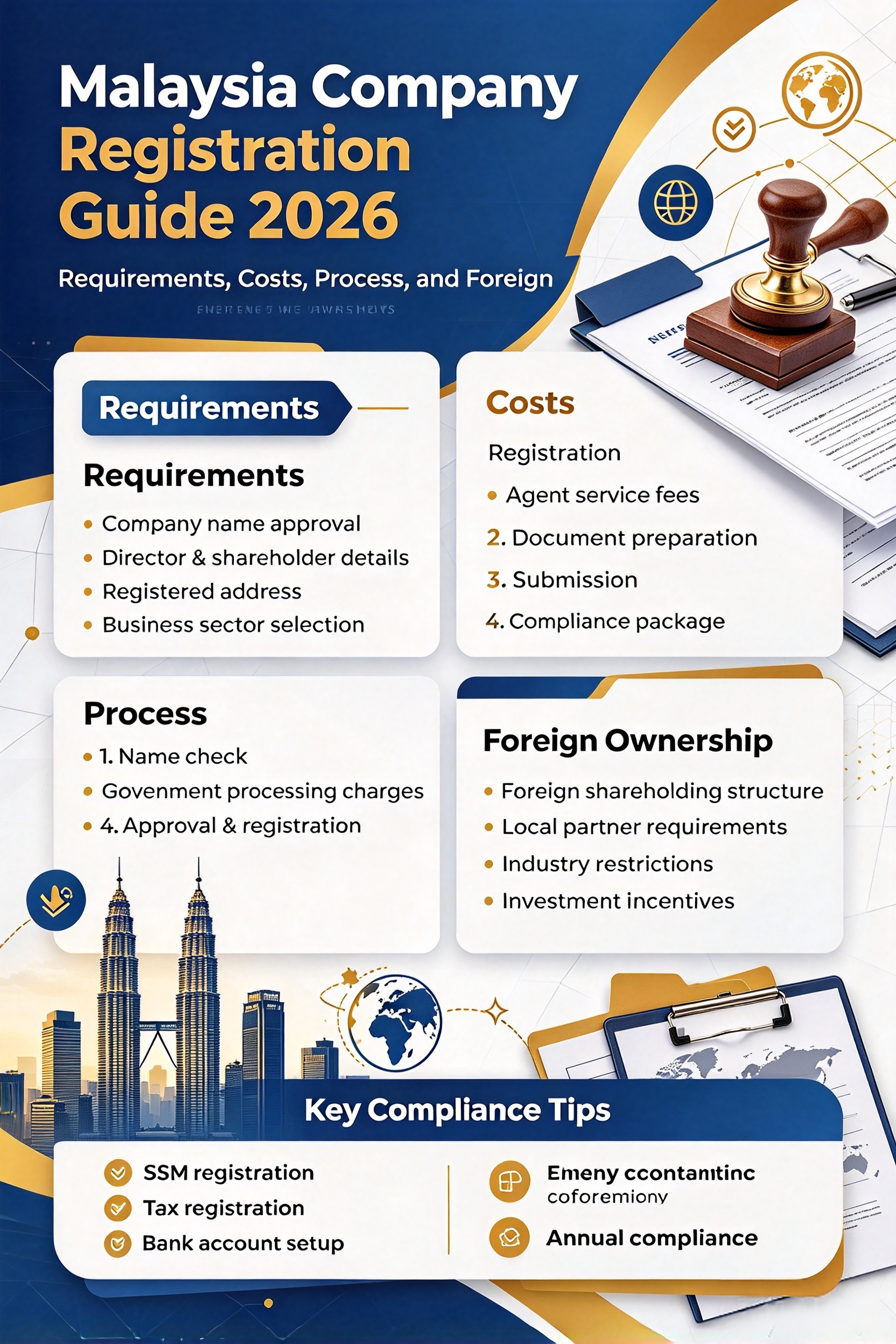
Malaysia Company Registration Guide 2026: Requirements, Costs, Process, and Foreign Ownership
Published: 2026-10-16 Views:
Malaysia Company Registration Guide 2026: Requirements, Costs, Process, and Foreign Ownership
1. Introduction: Why International Businesses Consider Malaysia
Malaysia has become an important location for companies seeking to expand into Southeast Asia. Its established manufacturing sector, international trade connections, developed commercial infrastructure, and access to regional markets make it an attractive option for businesses evaluating their next stage of international growth.
For overseas entrepreneurs, registering a Malaysian company can provide a local legal entity through which to conduct permitted business activities, enter into commercial agreements, recruit employees, purchase goods, and develop relationships with local customers and suppliers.
However, successful company registration involves more than obtaining an incorporation notice. Investors must select an appropriate legal structure, understand ownership requirements, arrange a compliant registered office, appoint the required corporate officers, and plan for banking, taxation, licensing, and ongoing reporting obligations.
This guide explains how Malaysia company registration works, what foreign investors should prepare, which costs to consider, and how to approach the process in a practical and commercially responsible way.
2. What Is the Most Common Company Structure in Malaysia?
For many international businesses establishing a new Malaysian operating entity, a private company limited by shares, commonly known as a Sdn. Bhd., is a structure worth evaluating.
Sdn. Bhd. stands for “Sendirian Berhad.” It generally provides a separate legal identity and limits shareholders' liability in accordance with applicable law and their obligations.
Under Malaysia's Companies Act 2016, companies are registered through the Companies Commission of Malaysia, known as SSM.
The main business structures that international investors may consider include the following.
Private Company Limited by Shares — Sdn. Bhd.
A Sdn. Bhd. is commonly considered for businesses that intend to operate locally, employ staff, enter commercial contracts, establish a sales presence, or build a longer-term regional operation.
Depending on the applicable sector rules, foreign investors may be able to hold all the shares in a Malaysian company. However, 100% foreign ownership is not an automatic entitlement for every business activity. Industry-specific licensing, equity conditions, regulatory approvals, and other restrictions may apply.
Registration of an Existing Foreign Company
An overseas corporation may consider registering the existing foreign entity in Malaysia instead of incorporating a separate local subsidiary.
This structure has different legal and registration implications. It should be evaluated carefully because the foreign company and a newly incorporated Malaysian subsidiary are not the same legal arrangement.
Representative or Regional Office
For certain businesses, a representative or regional office may be appropriate for approved non-revenue-generating functions, subject to the relevant authority's requirements.
Such an office should not be assumed to have the same commercial rights as a Malaysian operating company. The permitted activities and approval conditions must be confirmed before proceeding.
Practical recommendation: Businesses intending to sell products, sign contracts, employ staff, or build a local operating presence should compare the Sdn. Bhd. structure with other available options before making a decision.
3. Can Foreigners Register a Company in Malaysia?
Foreign individuals and overseas corporate investors can explore Malaysian company incorporation, subject to applicable legal and regulatory requirements.
A key distinction is that the right to own shares does not remove the requirement to satisfy the company's director and corporate administration rules.
According to SSM's published incorporation guidance, a private company must have at least one director who ordinarily resides in Malaysia and one promoter. The director must meet the relevant statutory eligibility requirements.
This is one of the most important considerations for overseas founders who live outside Malaysia.
Foreign Shareholders
Foreign shareholders may hold shares in a Malaysian company, subject to the requirements applicable to the company's proposed business activities.
Before incorporating, investors should verify:
Whether the intended business activity permits the proposed foreign ownership percentage.
Whether a sector-specific licence or approval is required.
Whether additional conditions apply to foreign participation.
Whether any minimum capital or investment requirements apply to the business or a particular licence.
Whether the proposed ownership structure matches the investor's commercial objectives.
Foreign ownership conditions should be checked at the industry and licensing level rather than assumed to be identical across the entire Malaysian economy.
Resident Director Requirement
A private company must have at least one director who ordinarily resides in Malaysia and has a principal place of residence there.
This requirement should be addressed before the incorporation application is submitted.
A resident director must meet the applicable statutory requirements and should understand the responsibilities attached to the position. Investors should not treat the appointment as a purely administrative formality.
Company Secretary Requirement
A Malaysian company must appoint at least one qualified company secretary within 30 days after incorporation.
The secretary must satisfy SSM's qualification, residence, and eligibility requirements.
The company secretary assists with statutory filings, corporate records, resolutions, and other company administration matters. The appointment should therefore be included in the company's initial setup plan.
Official reference: SSM, Incorporation of Company under the Companies Act 2016.
4. What Documents and Information Should Investors Prepare?
Preparing accurate information before submitting an incorporation application can help reduce unnecessary revisions.
The exact documents depend on the proposed structure, shareholder type, business activity, and applicable regulatory requirements.
A typical preparation checklist includes:
Proposed company name and alternative names.
Description of the proposed business activities.
Details of the shareholders and their intended ownership percentages.
Details of the proposed directors.
Passport or identity information and supporting documents requested for the relevant individuals.
Corporate registration documents and ownership information if a shareholder is another company.
Proposed registered office address in Malaysia.
Principal business address, if different from the registered office.
Proposed share capital and share allocation.
Additional declarations, consents, or supporting documents required for the specific application.
Where a foreign company is a shareholder, additional corporate documents may be necessary. Depending on the circumstances, certified copies, translations, or other formalities may also be required.
Investors should confirm the current document requirements with their company secretary or incorporation professional before arranging notarisation, certification, or translation.
5. Step-by-Step Malaysia Company Registration Process
Step 1: Define the Business Model
Start by identifying what the Malaysian entity will actually do.
For example, a trading company, software service provider, manufacturer, logistics operator, and regulated financial business may face very different requirements.
The proposed activities should be described accurately because they can affect licensing, ownership conditions, tax treatment, and operational permissions.
Step 2: Choose the Legal Structure
Decide whether a Sdn. Bhd., registration of an existing foreign company, or another permitted structure best fits the business.
Consider ownership, liability, management, expected operations, future investment, and the relationship between the Malaysian entity and any overseas parent company.
Step 3: Check and Submit the Company Name
The proposed name must be submitted through the applicable SSM process.
SSM provides options for direct incorporation and a separate name reservation process. Name approval remains subject to the relevant rules and availability.
A preferred name should not be treated as approved until the registration authority confirms it.
Step 4: Prepare Incorporation Particulars
Prepare the company information, shareholder details, director particulars, registered office information, business activities, and required declarations.
Check spelling, passport details, share allocations, and company activity descriptions carefully. Inconsistent information can lead to requests for clarification or amendments.
Step 5: Submit the Incorporation Application
The application is submitted through the applicable SSM online registration system.
The statutory registration fee for a company limited by shares is listed by SSM as RM1,000. This is the official incorporation fee, not the total cost of establishing and operating the business.
Additional professional fees, address services, secretary services, licensing expenses, banking-related costs, and other charges may apply.
Step 6: Receive Registration Confirmation
Once the application has been approved, the relevant registration notice will be issued.
Investors should retain the company's official registration documents and confirm that the registered information is correct.
Where a certificate of incorporation is required, investors should check the applicable SSM procedure and prescribed fee.
Step 7: Appoint the Company Secretary
The first company secretary must be appointed within 30 days after incorporation.
The company should also establish a calendar for statutory filings, resolutions, record keeping, and other recurring corporate obligations.
Step 8: Arrange Banking and Capitalisation
Opening a corporate bank account is a separate process from company incorporation.
Banks may conduct their own customer due diligence and request information about shareholders, directors, ultimate beneficial owners, the source of funds, the business model, expected transactions, and commercial counterparties.
Approval is not guaranteed simply because the company has been incorporated.
Investors should prepare a clear business plan, supporting commercial documents, ownership information, and evidence of the source of funds where requested.
Step 9: Review Licences and Tax Registration
Before beginning regulated or otherwise restricted activities, confirm whether the company requires additional approvals or licences.
The company should also assess its tax registration and reporting obligations, including corporate income tax, applicable indirect taxes, employee-related obligations, and any sector-specific requirements.
Incorporation alone does not automatically authorise every business activity.
6. How Much Does It Cost to Register a Company in Malaysia?
The total cost depends on the selected structure, professional support, business activity, and the services needed after incorporation.
For a standard company limited by shares, SSM lists an incorporation fee of RM1,000.
A name reservation, if used as a separate step, is listed at RM50 for every 30 days or part thereof, subject to the applicable maximum reservation period.
These official fees should be distinguished from the full setup budget.
| Cost category | What to consider |
|---|---|
| SSM incorporation fee | RM1,000 for a company limited by shares, according to published SSM guidance |
| Company name reservation | RM50 per 30 days or part thereof, if applicable |
| Company secretary | Initial appointment and ongoing statutory support |
| Registered office | Address provision and related services, where needed |
| Professional incorporation support | Preparation, submission, coordination, and advisory fees |
| Business licences | Depends on the industry and local requirements |
| Accounting and tax services | Depends on transaction volume, reporting obligations, and business complexity |
| Banking and capitalisation | Depends on the bank's requirements and the company's funding arrangements |
Investors should request a written quotation that separates government fees from professional service fees and recurring annual expenses.
They should also clarify what is excluded, such as licence applications, translations, additional regulatory approvals, accounting, tax filings, or work arising from changes in the original structure.
A low initial incorporation price does not necessarily mean a low total cost of ownership.
7. Taxation and Ongoing Compliance After Incorporation
Company registration is the beginning of the compliance process, not the end.
A Malaysian company should establish a practical system for managing its accounting records, statutory documents, tax deadlines, and corporate administration.
Corporate Income Tax
A company must assess its Malaysian corporate income tax obligations according to its circumstances.
The applicable rate may depend on the company's status, eligibility for particular tax treatments, income, and other statutory conditions. Investors should not assume that every company qualifies for a preferential rate.
Where cross-border transactions are involved, the company may also need to consider transfer pricing, withholding tax, treaty conditions, and the tax treatment of payments to overseas related parties.
Indirect Tax and Industry-Specific Obligations
Depending on the business model, the company may need to assess whether it is required to register for and account for relevant indirect taxes, including sales tax or service tax.
The answer depends on the nature of the activities, applicable thresholds, exemptions, and current rules.
Businesses operating in regulated sectors should separately confirm their licensing and reporting obligations.
Accounting and Statutory Records
The company should maintain appropriate accounting records, supporting documents, shareholder information, director records, and relevant corporate resolutions.
Annual return, financial reporting, audit, and tax filing obligations should be reviewed according to the company's circumstances and current Malaysian law.
Audit exemptions, where available, are subject to applicable eligibility rules and should not be assumed to apply to every small company.
Beneficial Ownership Information
Companies should also evaluate their obligations concerning beneficial ownership information and the maintenance or submission of required records.
The relevant individuals and reporting arrangements depend on the company's actual ownership and control structure.
Best practice: Establish a compliance calendar immediately after incorporation rather than waiting until the first annual filing deadline approaches.
8. Common Mistakes to Avoid When Registering a Malaysian Company
Mistake 1: Assuming All Industries Permit 100% Foreign Ownership
Ownership rules can differ by sector and licence. Verify the specific requirements for the proposed activities before finalising the shareholding structure.
Mistake 2: Ignoring the Resident Director Requirement
A private company must satisfy the Malaysian residence requirement for at least one director. This should be addressed early, with appropriate attention to the director's legal responsibilities.
Mistake 3: Treating Incorporation as a Banking Guarantee
Banks perform independent risk assessments and due diligence. Incorporation does not guarantee account approval.
Mistake 4: Confusing Registered Office Services With a Fully Operational Business Premises
A registered office serves a statutory purpose. It does not necessarily meet the requirements for a factory, retail outlet, warehouse, or other licensed premises.
Mistake 5: Underestimating Recurring Costs
Secretary services, accounting, tax compliance, licence renewals, and other obligations can continue after the initial incorporation fee has been paid.
Mistake 6: Choosing the Wrong Business Activity Description
An inaccurate or overly broad description can create difficulties when evaluating licences, ownership conditions, or the company's actual operational permissions.
Mistake 7: Delaying Tax and Compliance Planning
Waiting until the first filing deadline can increase administrative pressure and the risk of missing obligations.
9. How to Choose a Malaysia Company Registration Service Provider
A professional service provider should explain the registration process clearly and identify issues that need to be resolved before submission.
When evaluating a company registration consultant, consider the following questions:
Can the provider explain the differences between a Sdn. Bhd. and registration of an existing foreign company?
Will the provider assess the proposed business activities and flag potential licensing issues?
Are government fees and professional service fees itemised separately?
Does the proposed service include company secretary appointment and registered office arrangements, where needed?
Can the provider explain the director residence requirement and the responsibilities attached to the appointment?
Will the provider explain the difference between incorporation, bank account opening, licensing, and immigration approvals?
Is there a clear plan for ongoing accounting, tax, and statutory compliance?
Are the service scope, exclusions, timelines, and responsibilities documented in writing?
A reliable provider should avoid promising guaranteed bank approval, guaranteed licensing outcomes, or a universal incorporation timeline without reviewing the actual case.
The right service is one that helps the investor understand both the registration procedure and the obligations that follow.
10. Frequently Asked Questions About Malaysia Company Registration
Q1. Can a foreigner register a company in Malaysia?
Foreign individuals and overseas corporate investors can explore Malaysian incorporation, subject to the applicable company law, director residence requirements, business-sector rules, and licensing conditions.
Q2. What is a Sdn. Bhd.?
Sdn. Bhd. is the abbreviation for Sendirian Berhad, a Malaysian private company structure commonly used by operating businesses.
Q3. Is 100% foreign ownership allowed in Malaysia?
It may be permitted for certain activities, but it is not universal. The proposed industry, licence, regulatory conditions, and investment rules must be checked.
Q4. Does a Malaysian private company need a local resident director?
Yes. Under SSM's published incorporation requirements, a private company must have at least one director who ordinarily resides in Malaysia and has a principal place of residence there.
Q5. How many shareholders are required?
SSM's general incorporation guidance states that a company may have one or more members. The appropriate shareholding arrangement depends on the intended structure and applicable requirements.
Q6. What is the official SSM incorporation fee?
SSM lists RM1,000 for incorporating a company limited by shares. This does not include all professional services or ongoing operating expenses.
Q7. Must a company appoint a company secretary?
Yes. The first qualified company secretary must be appointed within 30 days after incorporation.
Q8. Does company incorporation guarantee a bank account?
No. Banks conduct independent due diligence and may request additional documentation or decline an application.
Q9. Can the company start operating immediately after registration?
Not necessarily. The company must verify whether its activities require separate licences, permits, approvals, tax registrations, or other conditions before commencing operations.
Q10. Does every Malaysian company need an audit?
Audit requirements depend on applicable law and the company's circumstances. Some companies may qualify for exemptions under the relevant rules, but eligibility should be confirmed rather than assumed.
Q11. Can an overseas parent company establish a Malaysian subsidiary?
Yes, this may be possible through an appropriate shareholding and incorporation arrangement, subject to applicable requirements. Corporate shareholder documents and additional supporting information may be necessary.
Q12. What should investors do before starting registration?
Confirm the business model, ownership structure, director arrangements, company name, registered office, licensing conditions, budget, and post-incorporation compliance plan.
11. Conclusion: Build the Right Malaysian Business Structure From Day One
Malaysia company registration can be an important step for international businesses seeking a stronger presence in Southeast Asia. For many operating businesses, a Sdn. Bhd. offers a structure worth evaluating, but the best choice depends on the company's commercial objectives and applicable regulatory conditions.
A well-planned incorporation process should cover more than the application itself. It should address foreign ownership, director eligibility, company secretarial arrangements, registered office requirements, banking preparation, licensing, taxation, and continuing statutory obligations.
Before proceeding, investors should verify current requirements with the Companies Commission of Malaysia (SSM), the relevant licensing authorities, and appropriately qualified Malaysian professionals.
The goal is not merely to register a company. It is to establish a compliant business structure that supports the company's long-term operations and regional growth.
Disclaimer: This article is for general informational purposes only and does not constitute Malaysian legal, tax, immigration, or investment advice. Requirements, fees, licensing conditions, and tax treatment may change. The illustrative case study is not a verified client success story. Investors should obtain advice tailored to their circumstances before taking action.