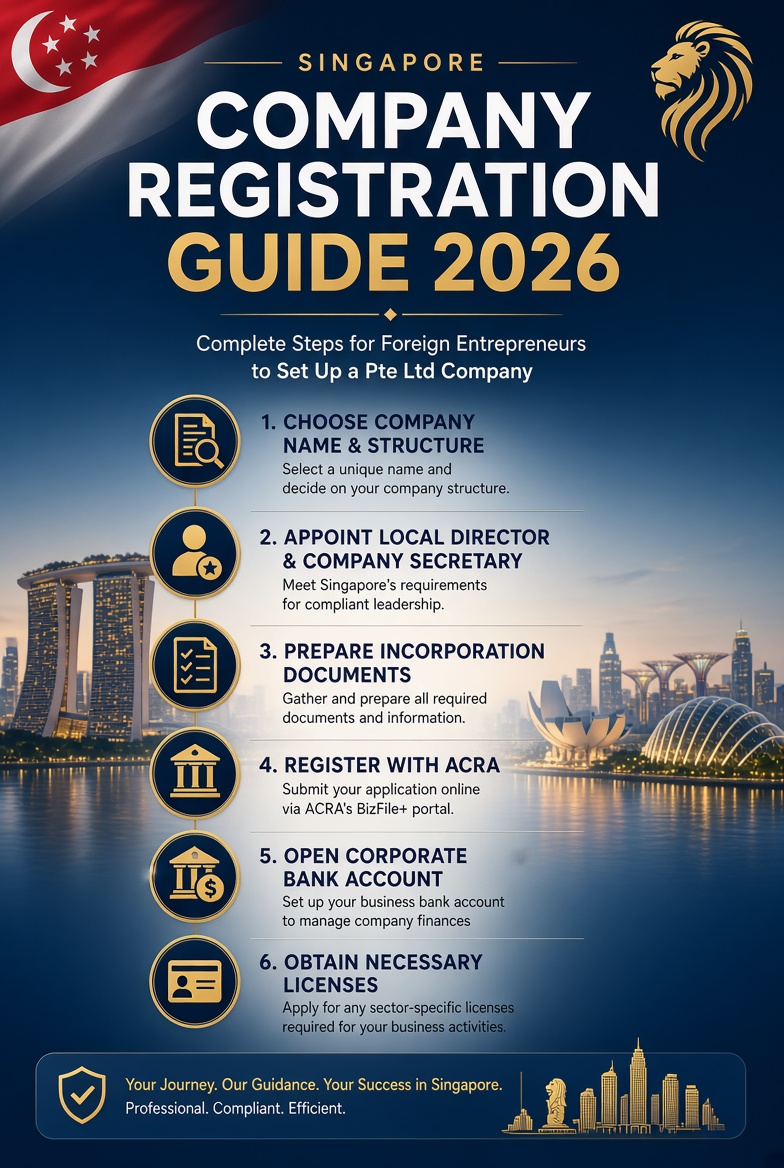
Singapore Company Registration Guide 2026: Complete Steps for Foreign Entrepreneurs to Set Up a Pte Ltd Company
Published: 2026-10-13 Views:
Singapore Company Registration Guide 2026: Complete Steps for Foreign Entrepreneurs to Set Up a Pte Ltd Company
Singapore has become one of the world's most attractive destinations for international entrepreneurs, technology companies, trading businesses, and multinational investors.
With its stable legal system, business-friendly policies, strategic location in Southeast Asia, and strong financial infrastructure, Singapore provides an ideal gateway for companies seeking access to Asian markets.
For many foreign entrepreneurs, registering a Singapore company—especially a Private Limited Company (Pte Ltd)—is the preferred choice because it provides limited liability protection, a professional corporate structure, and better credibility with international clients, banks, and investors.
According to the Accounting and Corporate Regulatory Authority (ACRA), Singapore's official business registry, companies can be incorporated through the Bizfile platform, while foreign founders generally need to work with a registered corporate service provider for incorporation procedures.
Why Choose Singapore for Company Registration?
Singapore is not only a regional business center but also a global hub connecting Asia, Europe, and North America.
Foreign entrepreneurs choose Singapore company registration because of several advantages:
1. Strategic Gateway to Asian Markets
Singapore provides easy access to major Asian economies, including:
- China
- Japan
- South Korea
- Malaysia
- Indonesia
- Thailand
- Vietnam
- India
Many international companies establish Singapore entities first before expanding into wider Southeast Asia.
A Singapore company can serve as:
- Regional headquarters
- Trading company
- E-commerce operation center
- Technology development base
- Investment holding company
- Consulting company
2. Strong Corporate Reputation
A Singapore registered company is often viewed as a reliable international business entity.
Many global customers, suppliers, and investors prefer dealing with Singapore companies because of:
- Transparent regulations
- Strong intellectual property protection
- Reliable banking system
- International business environment
3. Flexible Ownership Structure
Singapore allows foreigners to own 100% of company shares.
A typical Singapore Private Limited Company structure includes:
- One or more shareholders
- At least one local resident director
- One company secretary
- Registered office address
A Pte Ltd company is a separate legal entity, meaning shareholders generally enjoy limited liability protection.
What Is a Singapore Pte Ltd Company?
A Singapore Private Limited Company (Pte Ltd) is the most common company structure used by local and foreign entrepreneurs.
It is suitable for:
- Startups
- International trading companies
- Software companies
- Consulting firms
- Cross-border e-commerce businesses
- Investment companies
Key characteristics:
| Item | Requirement |
|---|---|
| Company Type | Private Limited Company (Pte Ltd) |
| Ownership | Foreign ownership allowed |
| Shareholders | Minimum 1 shareholder |
| Directors | Minimum 1 resident director |
| Company Secretary | Required within 6 months |
| Registered Address | Required |
| Incorporation Authority | ACRA |
ACRA provides different business structures and incorporation pathways depending on business objectives, ownership, and operational requirements.
Singapore Company Registration Requirements for Foreign Entrepreneurs
Foreign investors usually need to prepare:
1. Company Name
The proposed company name must be available and comply with Singapore naming regulations.
Examples:
- ABC Global Trading Pte. Ltd.
- Nova Technology Asia Pte. Ltd.
- Bright Future Consulting Pte. Ltd.
2. Shareholder Information
Required information includes:
- Passport copy
- Residential address
- Shareholding percentage
Foreign individuals or companies can become shareholders.
3. Director Requirement
Every Singapore company must appoint at least one director who meets local residency requirements.
A foreign entrepreneur who does not live in Singapore may appoint a qualified local resident director through professional corporate services.
4. Registered Office Address
Every Singapore company needs a local registered office address for receiving official communications.
5. Company Secretary
A Singapore company must appoint a qualified company secretary after incorporation.
The company secretary helps maintain statutory compliance and corporate records.
Step-by-Step Singapore Company Registration Process
Step 1: Choose Company Structure
Most foreign entrepreneurs select:
Singapore Private Limited Company (Pte Ltd)
because it provides:
- Limited liability
- Business credibility
- Investment flexibility
- Easier expansion opportunities
Step 2: Reserve Company Name
The company name application is submitted through Singapore's corporate registration system.
Approval depends on:
- Name availability
- Similarity with existing companies
- Restricted words
Step 3: Prepare Incorporation Documents
Typical documents include:
- Company constitution
- Shareholder details
- Director information
- Registered address details
- Passport documents for foreign shareholders
Step 4: Submit Registration Application
The incorporation application is submitted to ACRA through Bizfile.
Once approved, the company receives:
- Certificate of Incorporation
- Unique Entity Number (UEN)
- Business profile
Step 5: Complete Post-Incorporation Setup
After registration, businesses normally need:
- Corporate bank account
- Accounting system
- Tax registration
- Compliance management
Companies must also maintain required registers and fulfill ongoing filing obligations.
Shenzhen Ruibo Real Success Case: How a Chinese Technology Company
Expanded to Southeast Asia through Singapore Registration
Client Background
A Shenzhen-based software company specialized in artificial intelligence solutions wanted to expand overseas.
Their goals:
- Develop Southeast Asian markets
- Sign contracts with international customers
- Build a regional business center
- Improve global credibility
Initially, the company considered setting up in several countries but faced challenges:
- Different legal systems
- Banking difficulties
- Lack of local business reputation
Solution: Establish Singapore Pte Ltd Company
The company registered:
Future AI Solutions Singapore Pte. Ltd.
Business activities:
- Software development
- AI consulting services
- Technology cooperation
Registration structure:
- Chinese parent company as shareholder
- Singapore resident director arrangement
- Professional corporate secretary support
Results After Incorporation
Within six months:
- Successfully opened a corporate bank account
- Signed contracts with Southeast Asian customers
- Established Singapore as regional headquarters
- Improved trust among international partners
The company later used Singapore as a bridge for expansion into Malaysia, Thailand, and Indonesia.
Common Business Uses of Singapore Company Registration
1. International Trading Company
Singapore is widely used for:
- Import and export businesses
- Commodity trading
- Supply chain management
2. Cross-Border E-commerce Company
Many online sellers establish Singapore companies for:
- Global payment solutions
- Brand development
- International marketplace operations
3. Technology Startup
Singapore provides an attractive environment for:
- AI companies
- SaaS businesses
- FinTech startups
- Blockchain companies
4. Regional Headquarters
Multinational companies often use Singapore entities to manage Asian operations.
How Much Does It Cost to Register a Company in Singapore?
The total cost depends on service requirements.
Typical expenses include:
- Company registration fees
- Corporate secretary service
- Registered address service
- Resident director service (if required)
- Accounting and tax services
Foreign entrepreneurs should consider not only incorporation costs but also annual compliance expenses.
Common Mistakes When Registering a Singapore Company
Mistake 1: Choosing the Wrong Company Structure
Some entrepreneurs register without considering:
- Tax planning
- Future investors
- Business expansion
Mistake 2: Ignoring Compliance Requirements
After incorporation, companies must maintain:
- Annual filings
- Accounting records
- Corporate registers
Mistake 3: Banking Preparation Is Not Sufficient
Opening a corporate bank account may require:
- Business explanation
- Source of funds information
- Director verification
Preparation before application can improve approval efficiency.
Frequently Asked Questions About Singapore Company Registration
Q1: Can foreigners register a company in Singapore?
Yes. Foreign individuals and overseas companies can establish Singapore companies. Foreign founders generally need to engage a corporate service provider and meet local residency requirements.
Q2: Can foreigners own 100% of a Singapore company?
Yes. Singapore allows full foreign ownership of shares.
Q3: What is the most popular company type in Singapore?
The Private Limited Company (Pte Ltd) is the most popular structure for foreign entrepreneurs.
Q4: How long does Singapore company registration take?
A straightforward incorporation application can often be completed quickly after document preparation and approval.
Q5: Does a Singapore company need a local director?
Yes. At least one director must satisfy Singapore residency requirements.
Q6: Can I register a Singapore company remotely?
Yes. Many foreign entrepreneurs complete incorporation remotely through professional corporate service providers.
Q7: Can a Singapore company open a bank account?
Yes. A registered Singapore company can apply for corporate banking services.
Q8: Why do Chinese companies choose Singapore?
Common reasons include:
- International reputation
- Asian market access
- Stable regulations
- Global business environment
Q9: Do Singapore companies need annual compliance?
Yes. Companies must maintain corporate records and complete required filings.
Q10: Is Singapore suitable for startups?
Yes. Singapore is considered one of Asia's leading startup ecosystems.
Conclusion: Singapore Company Registration Is a Strategic Choice for Global Expansion
Singapore company registration is more than a simple incorporation process. For international entrepreneurs, it represents a strategic step toward entering Asian markets and building a global business presence.
With a professional structure such as a Singapore Pte Ltd, foreign investors can establish credibility, access international opportunities, and create a strong foundation for long-term growth.
For entrepreneurs planning global expansion, Singapore remains one of the most practical and reliable jurisdictions for company formation.